How extreme adventure shaped Isaac Kenyon’s view of resilience
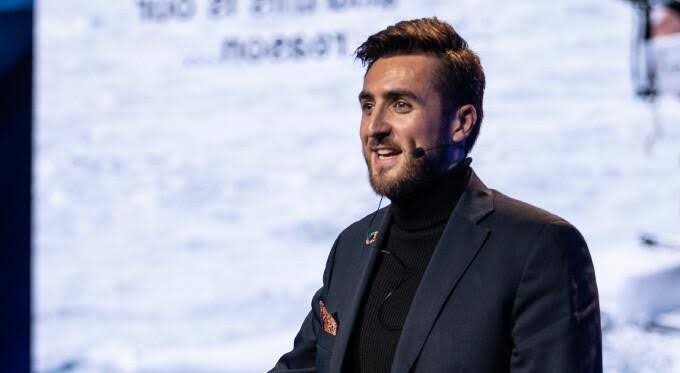
Isaac Kenyon has built his name in some of the toughest environments on earth, turning oceans, mountains and extreme eco-adventures into lessons on leadership, endurance and recovery.
A world-record eco-adventurer, scientist and keynote speaker, he is also a mental health expert whose work centres on resilience, mental wellbeing and sustainable leadership under pressure.
What makes his perspective land is the mix of lived experience and practical credibility behind it.
Kenyon is founder and CEO of Climate Explorers CIC, a trustee for mental health charity Mind, and a fellow of the Royal Geographical Society, the British Exploring Society, the Scientific Exploration Society and the Geological Society of London.
He has swum across seas, rowed oceans, climbed mountains and completed a full-distance Ironman wearing a 15kg weighted vest, while raising more than £1 million for global and local causes.
In this exclusive interview with the London Keynote Speakers Agency, Isaac Kenyon shares what travel through extreme environments has taught him about resilience, why burnout cannot be separated from purpose, and how leaders can build stronger, calmer cultures without losing performance.
Q1. In extreme, high-pressure eco-adventures, what leadership principles have helped you guide teams through uncertainty?
Isaac Kenyon: “I've done quite a few eco adventures in my time, like cycling the length of the UK over land and overseas, crossing seas, visiting UK national parks, climate solution projects, volunteering for environmental causes, filming carbon neutral documentary, all of these things in one package where there's absolutely loads of constraints and the pressure is really high.
“In those moments, it's taught me that it's not about pushing harder, it's about leading more humanely. Equally, I've also led high-pressure eco adventure rowing across the Atlantic Ocean, and those situations teach you very quickly that shouting doesn't really solve the problem of big waves.
“When conditions are uncertain, resources are limited, and the stakes are very high, I do have a framework of three things I think matter the most in those situations. I would say the first is clarity of purpose.
“In the middle of the ocean or in the middle of these big expeditions, when I'm just exhausted, I'm tired, it's really dark, it's scary, the motivation doesn't come from the targets. It actually comes from why you're there. So, I always find that teams are not burning out because the work is really hard. They're burning out because the work feels very much meaningless.
“I often find in this second point that sustainable performance is better than heroic effort. I've seen really impressive, really strong people who have really good intentions, but they're relying on brute force, and they're not actually looking at pacing, recovery and teamwork.
“All of the successful ventures I've ever done and all the records I've ever passed and great achievements have all come from managing energy, not just time, because when it comes to this sort of question, it's often about, oh, we haven't got the time for this, and that's the focus.
“It's all about time, but actually it's about managing energy because we are humans, and this is true in expeditions and in business.
“My third and final point is trust and connection. On an expedition, trust is survival. And if you don't have the trust, if you don't feel safe to speak up, or you're scared to admit fatigue, these small problems become really catastrophic. And in organisations, that's often when these bad decisions get made under pressure.
“So yeah, Eco Ventures have shown me that some of the biggest risks in outdoor challenges and in nature are pretty much the same in businesses, but they're not storms or competitors.
“They're actually burnout, disconnection, stress leadership. And that's why I really help organisations to kind of work to build a calmer, resilient, purpose-driven culture, because that means they can perform at their best without breaking. And I think that's the most important bit.”
Q2. What can organisations learn from the natural world about staying resilient, adaptable and focused during disruption?
Isaac Kenyon: “Nature is the ultimate teacher in resilience and adaptability. It's taught me a lot in my life.
“Organisations can learn a lot if they pay attention to the outside world. You never see a tree panicking because another tree is growing faster. But you do see that in business a lot.
“One lesson I take from the natural world is that diversity equals strength. So, in ecosystems, survival isn't about one species dominating. It's kind of a collaboration redundancy. There's a bit of flexibility. And organisations thrive the same way. Diverse teams, perspectives, and skills make decision-making under pressure faster and more resilient.
“A second lesson is pacing and energy management. In nature, no animal or plant is burning out trying to do everything at once. I see that in organisations all the time.
“Nature and animals and plants, what they're doing is adapting to the cycles around them, the environment around them, and organisations that can manage energy and recovery in cycles, which creates a sustainable performance that will prevent burnout while maintaining the focus and execution.
“The third is adaptation, which is continuous. Forests, rivers, and oceans are constantly adjusting to change, and they survive because they learn to respond rather than trying to control every variable. Successful organisations, I think, could do the same because they build cultures that actually embrace the change, experiment safely and iterate quickly.
“And finally, nature, this is my last point, I think nature actually is really important because it reminds us that purpose guides performance. So, every organism has a role in the ecosystem. When people understand their role, and they connect to a bigger purpose, engagement rises, stress decreases, teams are navigating the uncertainty with confidence.
“So in short, nature, I think it teaches us that resilience, focus, adaptability, they're not abstract concepts, they're practical observable principles, and I think organisations can embed them in culture, decision-making, leadership, and when they do, I'm very much certain, organizations I see do this, the performance under pressure does become sustainable and it's not exhausting.”
YOU MAY ALSO LIKE: Memory vs Reality: The elegant twist of travel

Q3. If leaders want to improve performance and well-being at the same time, what is the first mindset change they need to make?
Isaac Kenyon: “I really hope audiences take away a very simple but powerful belief that they can perform to a very high level without burning out because exhaustion is not a success strategy. Sustainable performance isn't slower, it's smarter.
“I really want leaders to leave feeling calmer, clearer, more confident, not just inspired for a day, but really equipped with what actually works, what they can implement, that can be applied immediately to create a culture where people just feel like they can perform really highly without breaking.
“And I want them to understand that burnout. It's not a personal failure on them. It's a design issue. And that is when you redesign how work actually happens; performance will improve rather than suffer.
“And then finally, I really want people to reconnect with their purpose, why work matters for them, how it connects to others, and how sustainable performance benefits people because that will help the organisation and the planet.
“So, having audiences walk away knowing that resilience isn't about enduring more pressure. It's about building cultures where energy regenerates, trust grows, and people can do their best work over the long term, and they can hit those ESG targets without feeling burnt out.
“And when that shift happens, individuals. They're going to thrive. Teams are going to reconnect. And that's what I really want. I want that to happen. So, organisations perform better for people and the planet.
This exclusive interview with Isaac Kenyon was conducted by Tabish Ali of the Motivational Speakers Agency.
READ NEXT: ‘I broke a world record and felt nothing’: Vicki Anstey on what success really costs