Travel opinion: Would you let AI plan your entire holiday?
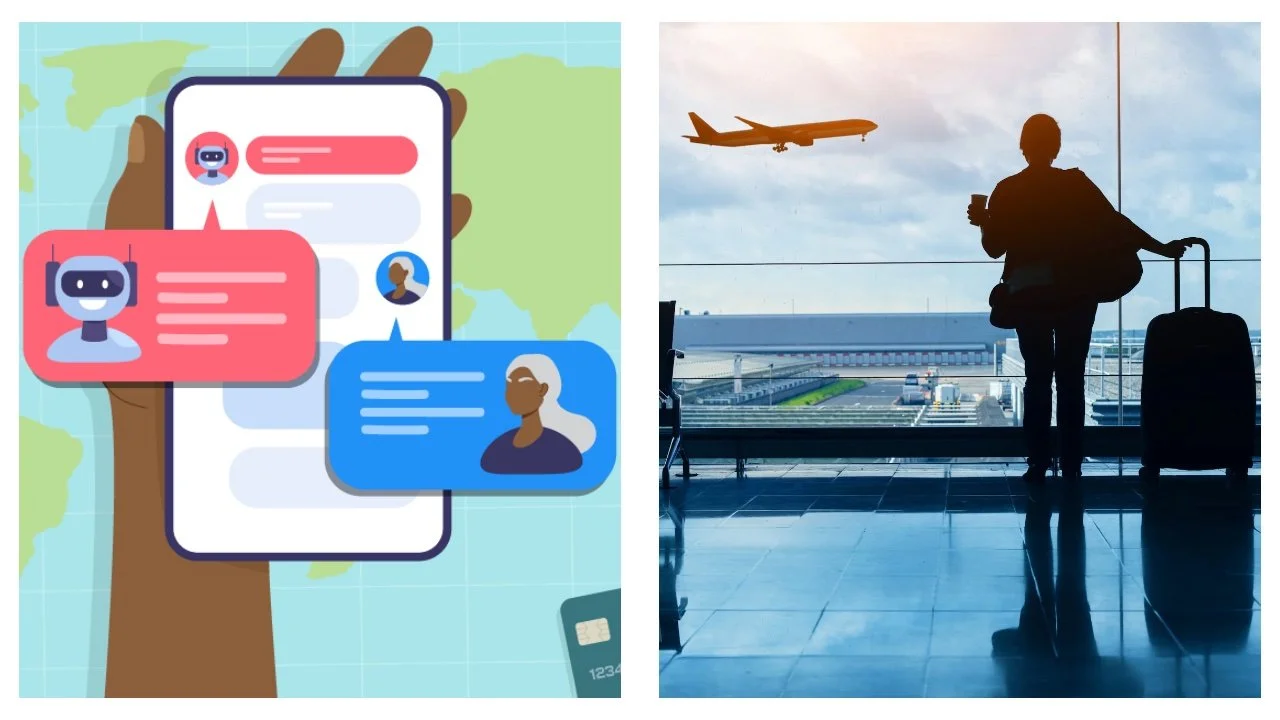
AI travel agents are reshaping the holiday experience as we know it, writes Travel News Blitz’s Jesse-Ann Baron.
AI’s involvement in travel planning has gone from a curiosity to a mainstream tool faster than anyone expected.
As is the case with many AI tools, the question has shifted and it’s no longer ‘if’ you’ll use one, it’s ‘when’.
What can AI travel agents actually do in 2026?
AI agents are not your usual run-of-the-mill chatbot; they are autonomous systems that can work independently.
These AI systems navigate websites, solve problems, execute bookings, service, pricing, and operational tasks without human input.
For example, an AI agent could book a dynamic personalised itinerary in minutes for a couple wanting a four-day romantic getaway with hidden-gem dining and art.
In simple terms, AI agents are travel assistants, but fully automated ones that can instantly personalise your trip plans.
Different AIs for different functions
Different AIs are used for specific kinds of assistance and examples include Hopper, Mindtrip, and Google's Gemini.
Hopper is best for price-sensitive travellers because it uses predictive analytics to show when the best time is to buy by alerting you when flights or hotel booking prices are about to be lowered.
Mindtrip is known for visual activity planning through generating an interactive map that plots your day-to-day itineraries with restaurant, activity and transportation recommendations.
Google’s Gemini is similar to ChatGPT as a conversational travel assistant, but they leverage Google data for fast research, itinerary generation and decision support.
Each of these tools have their own strong points, but as AI automated systems improve, AI agents will likely eventually combine all these skills.
Increased trust from users
AI travel agents can suggest destinations based on your search history, do dynamic bookings while adapting to real-time changes, easily construct a personalised itinerary and all this with 24/7 customer service.
Based on Booking.com’s 2025 Global AI Sentiment Report, 91% of global respondents are excited for AI, and 89% expressed their desire to use AI for future travel planning.
There is a clear upward trend with stats collected from Skyscanner's 2025 travel trend insight showing that more people are confident in using AI for planning and booking trips.
They noted a rise with 47% in 2024 to 54% in 2025, with an expected upward trajectory in the future.
The capabilities of AI travel agents are impressive and very promising, but the real question is whether we would ever trust them over a human.
READ MORE:Worlds colliding: The best culture exchanges from the 2026 FIFA World Cup

Is AI good enough to book your holiday?
Planning your trip using AI is comfortable for most people, but when money is involved, it's natural that the average traveller becomes cautious.
Expedia Group is one of the world's leading travel technology companies and online travel agencies.
They did a 2026 AI Trust Gap report where they found that 66% of consumers do not trust AI to book on their behalf.
It is clear from their other data that people are becoming more comfortable using AI as suggestive support, but not as a definitive decision maker.
This is likely because of how high-stakes travel is, with one wrong move costing you thousands or ruining a rare, planned vacation.
People do not trust AI
Expedia Group found there are three main concerns amongst travellers with allowing AI to buy and book:
Loss of control (57%)
Data Privacy (57%)
Misuse of personal data (56%)
Trusted travel brands are still preferred over AI agents for the crucial final step of booking.
Travellers do not just want travel convenience, but rather accountability; if something goes wrong, they want the flexibility to change and support from trusted travel brands.
Even if AI travel agents are a viable option, Expedia’s statistics show that people still choose trusted travel companies, with 68% choosing them over automated systems.
However, AI’s development is pointing towards a shift in perceptions, which is why major platforms like Booking.com are embedding AI into their booking layer.
The infrastructure is constantly being built; the missing piece from AI’s total domination is society’s perceptions and distrust of it.
READ MORE: Travel review: Palermo, Sicily - the food that took my trip to the next level

What can’t AI agents do yet when it comes to travel?
AI travel agents are a new, growing phenomenon, but like everything, it has limitations.
When things hit the fan, AI cannot plan.
In the travel industry, it is never smooth-sailing with unpredictable obstacles like unforeseen weather disruptions, cancelled flights or overbooked hotels.
AI agents cannot actively negotiate with airline staff, secure emergency compensation or rebook alternative transport, especially not in a quick or urgent scenario.
This, however, is where the role of human travel agents thrives, and it’s in these cases where the vulnerabilities of AI’s logic is highlighted.
An AI travel agent will only parse context and not nuances of complex cancellation policies or the different ambience a place provides.
Intricate itineraries carefully curated by big corporate groups are a step above the generalised, estimated suggestions AI can provide.
There are other factors which AI also fails to take into account, especially simultaneously, such as balancing loyalty statuses, planning over multiple different time zones and managing different dynamics all at once.
But perhaps the biggest pitfall of AI is the blurriness around trust and privacy.
People value their privacy and secure information, so when they need to hand over a passport and payment information, many prefer a trusted human over an AI that stores and shares their data.
Should you use an AI travel agent for your next trip?
The answer is not clear-cut.
The level of AI you should rely on for your travels depends on the plans you intend to make.
If you are looking for something simple and straightforward, then AI can be quite useful to assist your decision-making.
AI travel agents will handle the planning, price predictions and inspiration faster and cheaper than any other method, particularly if you aren’t looking at multiple destinations or flights.
If you’re in an early planning phase, AI does make for a convenient starting point.
However, when you move past ideation into more serious commitments, especially for situations such as a multi-country itinerary, a honeymoon or a big group trip, a human agent or trusted travel platform is definitely the smarter option.
Travel agents will not be fully replaced by AI because the automated systems lack taste, nuance, instinct and complexity.
However, they will be used as a bridge by agencies to make travelling and the organising process more efficient.
The final verdict
The ultimate approach in 2026 is a hybrid.
A modern traveller will know when to use an AI travel agent or a human one.
Even though more people are using AI for research and inspiration, humans will still remain most trusted for confirmations, bookings and support.
However, as the tides continue shifting, AI is here to stay, whether you are ready or not, and it is beckoning in a whole new era of travel.
READ NEXT: Benidorm travel tips: Things to do, see and explore